Flat Roof Coatings: Do They Work, and When Are They Worth It?
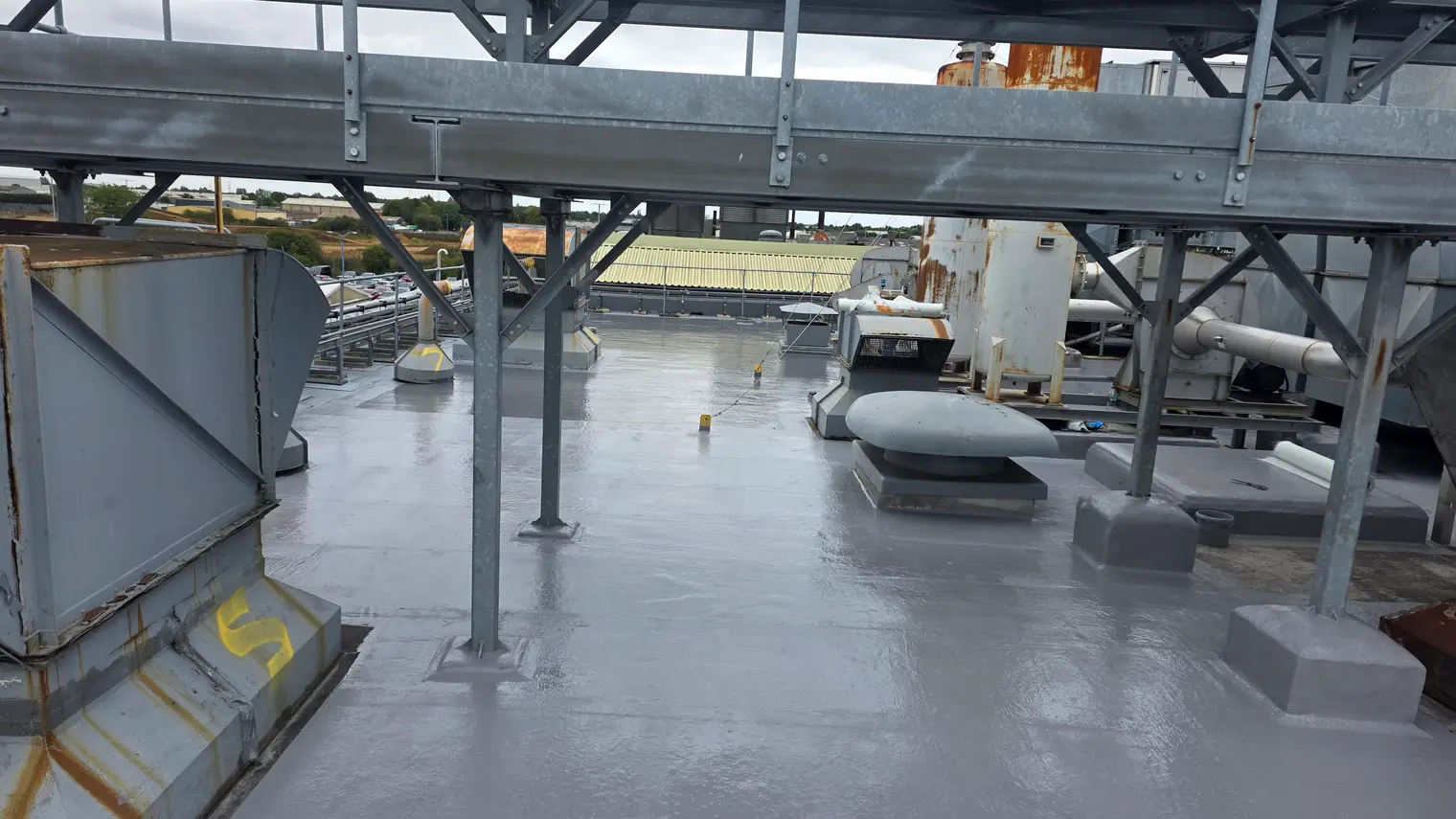
“Can’t you just paint something on it?” It’s one of the most common questions we’re asked, and it deserves a straight answer rather than a sales pitch. Sometimes coating a flat roof is genuinely the smartest money you can spend. Other times it’s the most expensive way to delay a job by two years. Here’s how to tell the difference, from a firm that fits coatings but won’t sell you one you don’t need.
“Coating” means two very different things
Most of the confusion comes from one word covering two completely different products.
The first is a tin of roof sealant from a DIY shop, brushed over a tired roof. It’s thin, unreinforced and goes onto a surface that hasn’t really been prepared. It’s a cosmetic fix.
The second is a professional liquid waterproofing system, PMMA or polyurethane resin applied cold with a reinforcing fleece embedded into it, over a primed and prepared surface. It cures into one continuous, fully bonded membrane with no laps or joints, and it carries a manufacturer-backed guarantee of around 20 years.
Those are not two grades of the same thing. They are different products doing different jobs, and only one of them is a roofing system.
When coating genuinely works
A liquid overlay is a proper, cost-effective option when:
- The deck and insulation underneath are dry and sound. This is the big one. Liquid waterproofs the surface; it can’t dry out what’s already wet below.
- The existing covering is worn but intact, rather than split all over. Liquid bonds well to sound felt, asphalt, concrete and metal.
- The roof is complex or heavily detailed. Where a sheet membrane would be fiddly around pipes, upstands and plant, a liquid simply flows around everything. Our guide to liquid roofing vs single ply covers this in more detail.
- It’s a balcony, terrace or walkway, where a trafficable anti-slip finish is needed.
- Disruption has to be kept down. It’s cold-applied with no flame, so it suits occupied buildings, and PMMA cures within the hour.
In those situations you get a genuinely seamless, guaranteed roof without the cost and mess of a full strip. That’s good value, and we’re happy to recommend it.
When coating is a false economy
Coating cannot fix a roof that has failed structurally. If water has already got into the build-up, painting over the top seals the moisture in. The insulation stays wet, the deck keeps deteriorating, and the coating blisters as trapped moisture tries to escape. You’ve then paid for a coating and still need the roof replacing.
Be sceptical about coating if:
- There are damp patches or staining on the ceiling below, which usually means water is already in the structure.
- The deck feels soft or springy underfoot.
- The covering is split, blistered or crazed across the whole roof, rather than tired in a few places.
- There’s persistent ponding water. Coating doesn’t correct falls or drainage, so the water simply sits on a new surface.
- The roof shows several of the signs it needs replacing.
We survey plenty of roofs around Doncaster where the honest answer is that a coating would be throwing good money after bad, and we say so.
How often should a roof be resealed?
Ideally, never. A correctly specified system is designed to see out its guarantee, not to be topped up every few years. If a roof genuinely needs recoating on a short cycle, that’s the covering telling you it’s reached the end of its life.
That’s also why we fit welded single ply for most full replacements. There are no glued laps to lift, unlike EPDM rubber, and nothing rigid to craze and crack the way GRP fibreglass does, so there’s nothing to keep resealing.
Get a straight answer about your roof
The only way to know which category your roof falls into is to look at it properly, including what’s underneath. We survey for free and give a fixed written quote, whether that’s for a liquid overlay, a targeted repair or a full replacement. Our cost guide explains what drives the price either way.
We cover Doncaster, Rotherham, Barnsley and the towns listed on our areas page.
Request a free quote or call 07973 436 305.
Frequently asked questions
Can you coat a flat roof instead of replacing it?
Sometimes, and when the conditions are right it is excellent value. A professional liquid system can be applied over a sound existing roof to add a fresh, seamless waterproof layer without a full strip. It only works if the deck and insulation underneath are dry and sound, which is what a survey establishes.
How often should you reseal a flat roof?
A properly specified system should not need resealing on a cycle at all. A liquid system installed to manufacturer specification carries a guarantee of around 20 years, and a welded single ply roof 20–25 years. If someone is telling you the roof needs recoating every few years, that is a sign the original covering is past its best.
Do DIY flat roof sealants work?
A tin of sealant from a DIY shop will usually buy you a season or two on a small area, no more. It is thin, unreinforced and painted onto a surface that has not been properly prepared. The bigger risk is that it hides a problem rather than fixing it, so water keeps getting into the deck while the roof looks fine from below.
How much does a flat roof coating cost in Doncaster?
It depends on the area, the state of the existing surface, how much detailing is involved and access, so an honest figure needs a look at the roof. We survey for free and give a fixed written quote, and we will tell you plainly if coating is not the right answer for your roof.
Do you offer flat roof coating services near me?
If you are within about 20 miles of Doncaster, almost certainly. We are based in Armthorpe and install PMMA and polyurethane liquid systems across Rotherham, Barnsley, Mexborough, Thorne, Bawtry, Epworth and the surrounding towns.